A customer engagement solution is any platform, tool or program that gives consumers a reason to interact with your brand after (or before) they buy. That covers a lot of ground, from support desks and CRMs to loyalty programs, promotions and branded games. If you’re a brand marketer, the test that matters is whether the customer engagement solution brings in sales and first-party data you can actually use.
Most articles on customer engagement solutions are written with support teams in mind. This one is for the marketer who needs consumers to show up, take part and come back.
A customer engagement solution is the mix of technology and planning a brand uses to keep consumers interacting with it over time. The software does the delivering. Your customer engagement strategy decides what each interaction is supposed to achieve.
You need both. A powerful tool with no clear purpose will give you plenty of activity and very little to show for it.
The term gets stretched in every direction. Depending on who’s selling, customer engagement software might mean a live chat widget, a points program, an email platform or an instant win game.
Search results add to the confusion. Most of the top-ranking articles treat customer engagement as a support and CRM job, focused on answering questions faster.
Brand marketers tend to mean something else. You want consumers to choose to participate, whether that’s entering a sweepstakes, playing a game or joining a loyalty program, and that goal changes which customer engagement platform makes sense for you.
There are six main types of customer engagement solutions: CRM and marketing automation, support tools, loyalty programs, email and mobile messaging, feedback tools, and gamified promotions. Each one plays a different role in the customer journey. Most brands run a few of them side by side.
A CRM and marketing automation platform keeps your customer data in one place and uses it to send automated, targeted messages. Segmentation lets you group consumers by behaviour, like recent buyers or people who haven’t purchased in a while. Personalization uses that same data to change what each consumer sees.
For most brands, the CRM is the backbone of the engagement stack. Its limit is that a CRM organizes relationships you already have. A CRM on its own won’t give a new consumer a reason to engage.
Customer support tools answer consumer questions through help centres, live chat and chatbots. Good support tools cut wait times and improve the customer experience for people who already need help.
Support tools only kick in once a consumer reaches out. That’s useful, but support tools rarely spark new interest in a brand.
Loyalty and rewards programs give consumers points, tiers or perks for buying again and taking other actions. Well-run loyalty programs build customer loyalty and customer retention because members have a reason to stick with you.
Plenty of loyalty programs also run sweepstakes and instant win games inside the program to keep members active between purchases. One large technology company’s loyalty program, for example, runs promotions across dozens of countries. In practice, the types of customer engagement solutions overlap a lot more than vendor categories suggest.
Email and mobile messaging let you reach opted-in consumers directly with offers, updates and reminders. SMS, RCS (a richer kind of text message with images and buttons) and business messaging apps now sit next to email as standard multichannel tools.
Direct messaging is only as good as the consent list behind it. If you’re texting consumers in Canada, you’ll also want a messaging provider with direct carrier connections. IC Mobile explains how trusted messaging works at scale for brands sending high volumes.
Feedback and survey tools collect consumer opinions through surveys, ratings and short forms. Survey results help you spot problems early and understand how satisfied people are.
Most brands use feedback tools now and then, not every day. Surveys make your decisions better, but a survey rarely moves sales by itself.
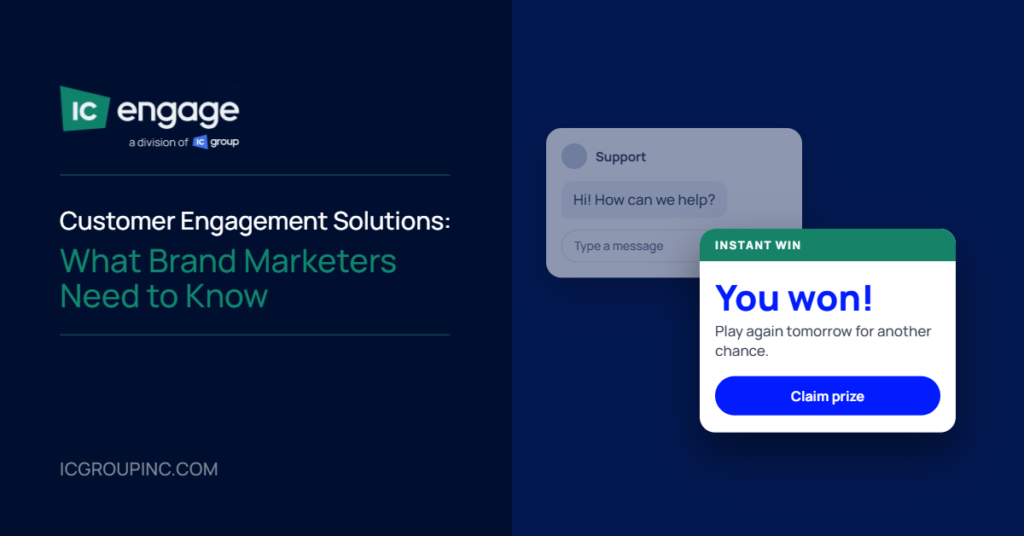
Gamified promotions and interactive experiences include instant win games, sweepstakes, contests, trivia and live event fan activations. Consumers opt in to play, so every entry is a first-party data point your brand owns. You can also tie a gamified promotion to a purchase, which connects engagement straight to sales.
The IC Engage digital promotions and MarTech solutions cover instant win games, sweepstakes, insured prize promotions, social media promotions and rebates. If you’re weighing your first program, IC Group’s guide on whether your brand should run a sweepstakes is a good place to start.
Instant win games are often where brands begin, since consumers find out right away whether they’ve won. IC Group’s guide to running a prize wheel promotion covers one of the simplest instant win formats.
Live events are the other big setting for gamified engagement. Fan engagement platforms turn spectators into players with in-venue trivia, predictions and contests, which IC Group covers in how fan activations move audiences from watching to participating. You can browse working game formats in the IC Group Experience Hub.
Here’s how the six types of customer engagement solutions compare.
| Type | Best for | Where it falls short for consumer brands |
|---|---|---|
| CRM and marketing automation | Organizing data and automating journeys | Needs a reason for customers to engage in the first place |
| Support tools | Answering questions at scale | Reactive, only reaches customers who already have a problem |
| Loyalty programs | Repeat purchases from existing customers | Slow to build, mostly reaches people already buying |
| Email and messaging | Direct reach to opted-in customers | Only as good as the consent list and the offer |
| Feedback tools | Understanding satisfaction | Low frequency, limited sales impact |
| Gamified promotions | Participation, data capture and sales lift | Needs compliant rules and prize planning |
A customer engagement solution should give you results you can measure: repeat purchases, stronger loyalty, first-party data and more consistent communication. Clicks, opens and plays only count if they lead to one of those.
The clearest sign a customer engagement solution is working is consumers buying more often. Purchase-linked promotions and loyalty rewards give people a direct reason to come back, and you’ll see it in your repeat purchase rate.
Sales lift is easiest to prove when the engagement is tied to a transaction. A receipt upload, a product code or a purchase-based entry links each interaction to a sale.
Customer engagement solutions build customer loyalty by keeping your brand in front of consumers between purchases. People who interact with a brand regularly are less likely to drift to a competitor, so churn goes down.
Lower churn adds up over time. Keeping a current consumer active usually costs less than winning a new one.
First-party data is information consumers give your brand directly, like an email address, a preference or a purchase history. Gamified promotions are one of the most efficient ways to collect first-party data, since people share details for a chance to win.
First-party data matters more now that third-party tracking is less reliable. When you own your consumer data, you control your own segmentation and personalization instead of relying on a platform to do it for you.
A well-connected customer engagement solution keeps your messaging consistent across email, SMS, social and in-store. With consistent omnichannel communication, a consumer who enters a promotion online sees the same offer in the follow-up text.
Your internal teams benefit too. When marketing and loyalty teams work from the same data, they stop sending the same consumer two different offers in one week.
Pick the customer engagement solution that matches a specific business goal, connects to your current tech stack and is realistic for your team to run. Then check reporting and scalability. A tool that can’t prove results or hold up during a big campaign won’t last long.
Your business goal decides which type of customer engagement solution fits. Awareness, data capture, sales and loyalty each call for something different.
Write the goal down before you talk to a single vendor. It keeps the conversation on outcomes instead of feature lists.
Your customer engagement solution should connect to the CRM, e-commerce platform and analytics tools you already use. Good integrations move data between systems automatically, so consumer information doesn’t get stuck in silos.
Ask every vendor which integrations are native and which need custom work. Custom integrations add time and cost to every campaign you run.
The right customer engagement platform is one your marketing team can actually operate day to day. Look at how fast a new campaign can launch and who on your team will own it.
Some brands want a self-serve tool. Others would rather hand the build and day-to-day running to a managed partner. Either works, as long as it matches the time and people you have.
Analytics and reporting should connect engagement activity to the numbers your leadership cares about. Entries and plays are a start. The report that justifies next year’s budget also shows sales and new opt-ins.
Ask for a sample report before you sign anything. You’ll see quickly whether the vendor measures what you need.
Scalability means your customer engagement solution keeps working during your busiest stretches, like a holiday campaign or a major sports event. A platform that slows down during a traffic spike hurts the customer experience at the worst possible moment.
If you’re a global brand, check geographic reach too. IC Group runs programs in more than 30 countries, and every new market brings its own rules.
Before you launch a promotion, check that your contest rules are legal everywhere you’re running, that you have consent to message participants afterward, and that your prize budget is protected. None of the top-ranking guides on customer engagement solutions mention any of this, and it’s where promotions most often go wrong. IC Group’s guide to what makes compliant gamified digital promotions hard to run walks through the full list of risks.
Getting compliance right also protects consumer trust. Fake prize offers make people suspicious of every promotion, including yours.
By the numbers: prize fraud in the U.S.
According to the Federal Trade Commission’s Consumer Sentinel Network Data Book 2024, prizes, sweepstakes and lotteries were the sixth-largest U.S. fraud category in 2024. About one in five of those reports (22%) involved lost money, totalling US$351 million. The median loss was US$1,000, roughly double the US$497 median across all fraud.
| Fraud category (U.S., 2024) | Median loss (USD) |
|---|---|
| Prizes, sweepstakes and lotteries | $1,000 |
| Imposter scams | $800 |
| All fraud reports | $497 |
| Online shopping | $130 |
According to FTC guidance on sweepstakes scams, a legitimate promotion will never ask a winner to:
Clear rules and a recognizable sponsor make it much easier for consumers to tell your promotion apart from a scam.
Contest rules change from country to country, and sometimes from province to province. In Canada, the Competition Act and the Criminal Code govern promotional contests, which is why most Canadian contests have a skill-testing question and a free, no-purchase way to enter.
If your team is used to U.S. promotions, the skill-testing question tends to be the first surprise. The Canadian Marketing Association’s Contests 101 guide for marketers explains what Canadian contest advertising has to disclose, including the number and approximate value of prizes. Contests open to Quebec residents also have French-language requirements.
Regulators are paying closer attention. Miller Thomson’s practical guide to contest compliance risk lays out what Canadian contest sponsors should have in place before launch, and IC Group’s overview of sweepstakes management and contest administration shows how a partner can handle rules, entries and winner checks.
This section is general information, not legal advice. Confirm contest rules with qualified counsel in each market you run in.
A promotion entry doesn’t automatically give you permission to send marketing messages. In Canada, Canada’s Anti-Spam Legislation (CASL) requires consent before a business sends commercial emails or texts, and every message needs a working unsubscribe option.
The Government of Canada’s overview of CASL covers the rules and the penalties. The simplest fix is a clear consent checkbox on the entry form, which turns promotion participants into an audience you can actually market to.
Prize indemnity insurance lets you offer a huge prize without setting aside the full amount. You pay a set fee to an insurer, and if a consumer wins, the insurer pays the prize. Think of a hole-in-one contest or a fan taking a million-dollar shot at a game.
Prize indemnity insurance is what makes headline prizes possible for brands that don’t have a million dollars sitting idle. ICI, IC Group’s specialty insurance division, explains how prize coverage makes bold promotion ideas possible.
If you’re planning a promotion with a big or unpredictable prize payout, you can talk to the IC Engage team about building the prize structure and the rules together.
Customer engagement is working when participation goes up and business results follow. Both sets of numbers should tie back to the goal you set at the start.
Participation metrics tell you how many consumers are taking part and how often. The usual ones are:
Business outcome metrics tell you whether engagement is turning into revenue and loyalty. The main ones are:
Where you can, compare participants with non-participants. A gap in CLV or AOV between the two groups is the clearest proof a program is paying off.
Every metric should connect to your original business goal. Judge a data-capture campaign on qualified opt-ins and a sales campaign on purchase lift.
Matching metrics to goals saves you from a familiar trap: a campaign that looks great on entries and does nothing the business needed.
A few questions come up in almost every conversation about customer engagement solutions. Here are short answers you can pass along to your team.
A CRM stores and organizes customer data. A customer engagement solution uses channels, offers and experiences to get consumers interacting with your brand. Many brands treat the CRM as the data layer and add engagement tools, like promotions or loyalty programs, on top of it.
Most brands use more than one customer engagement solution, since each type does a different job. A common setup pairs a CRM and a loyalty program with an email and messaging platform, plus gamified promotions a few times a year. What matters is that the tools share data through integrations.
You’ll usually see participation numbers as soon as a campaign goes live. Loyalty and lifetime value take longer, because those depend on repeat behaviour over several months. Set your measurement windows before launch so everyone knows when to judge the results.
Picking a customer engagement solution starts with a plain question: what do you want consumers to do, and what would make them want to do it? Answer that, plan for the rules that come with it, and the right type usually becomes obvious.
Join our newsletter to stay informed with the latest IC Group announcements.
Orchestrating powerful digital connections between brands & people.
We use cookies to improve your experience and analyze how our website is used. Essential cookies enable core site functionality, while optional cookies help us understand usage and support marketing activities.
You can accept all cookies, reject non-essential cookies, or manage your preferences at any time.
Learn more in our Cookie Policy and Privacy Policy.
Manage your cookie preferences below:
Essential cookies enable basic functions and are necessary for the proper function of the website.