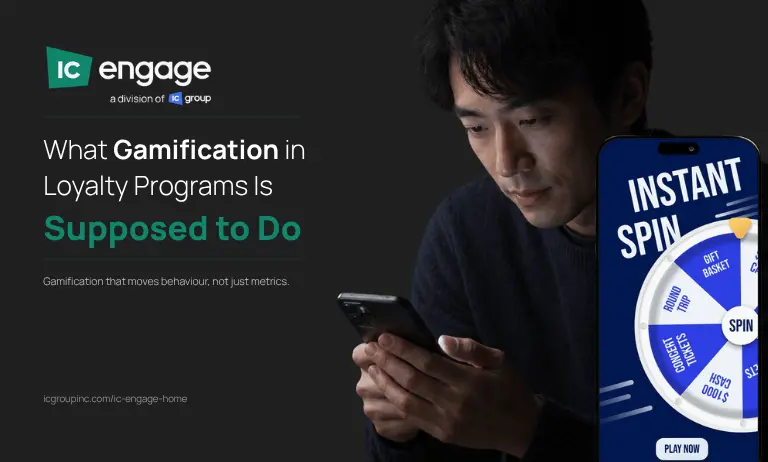
Gamification in loyalty programs is the use of game mechanics to change member behaviour, not to generate activity. Done well, it moves purchase frequency, product trial and referrals. Most programs instead reward logins, badges and check-ins, which lift engagement reporting while leaving the behaviour underneath, and the revenue attached to it, unchanged.
Think about a member who enrolled in your program, earned a reward or two, and then went silent. Now think about what it would take for them to come back and do something they wouldn’t have done otherwise. Not log in. Not collect a badge. Change their behaviour in a way that shows up in your numbers.
That is what gamification in loyalty programs is built to produce. It rarely does.
The reason comes down to execution. Login streaks, badges, daily check-ins. Those numbers move, but the member behaviour underneath them often doesn’t.
The distinction between the two is where most gamification strategies quietly fall apart.
Consider a streak mechanic that rewards a member for opening an app seven days in a row. On the surface it reads as engagement. But if that member never makes a purchase, refers a friend, or deepens their relationship with the brand, the streak produced nothing.
The difference comes down to what the mechanic is optimized for:
Same game logic. Completely different outcomes. One is optimized for the metric. The other is for the behaviour.
That gap, between measuring what is easy and measuring what matters, is where the value leaks out.
Three questions, and they have to be answered in this order.
Most brands skip these, move straight to the mechanic, and optimize toward whatever the platform makes easy to track. The result is a program that looks healthy in reporting and flat everywhere else.
When these questions aren’t considered up-front, no amount of creative execution can fix it.
Start with the behaviour and work backwards to the mechanic. The same game logic can be pointed at almost anything, which means what it is pointed at is the entire decision.
If the behaviour is purchase frequency, the trigger is a second purchase inside a defined window, not a seventh consecutive login. If it is product trial, the reward attaches to trying something outside the member’s usual basket. If it is referral, entries are earned by bringing someone in, not by showing up.
Each of those uses mechanics you already recognise. What changes is the unlock condition. A mechanic that unlocks on a behaviour you can put a revenue number against will show up in that number. One that unlocks on an app open will show up in app opens.
The catalogue of mechanics is not the hard part. Our Experience Hub walks through the range of them. Deciding which behaviour each one is tied to is where programs are won or lost.
Executing consumer engagement programs for the past 35 years teaches you the answer. It almost never sits in the creative. It sits in the architecture. The brands that see real results from gamification in loyalty programs are not running flashier mechanics. They are running ones that were built around specific behaviours from the start.
One global technology leader runs its loyalty program in more than 50 countries on exactly that basis. Always-on instant-win games and large-scale sweepstakes are pointed at three defined behaviours: retaining users, re-engaging dormant members, and driving digital usage. Tens of thousands of members redeemed points for chances at $10,000 prizes, and one recent program awarded a $1 million prize. As Jill Goldworn, our SVP of Sales, describes it, campaigns like these drive commerce, reduce churn, increase time spent in app, and deliver first-party data that fuels ongoing marketing.
That is the difference between a program that moves your numbers and one that just tracks them.
IC Engage builds and integrates within loyalty programs to move behaviour, not just metrics. If your gamification strategy isn’t delivering, it’s worth a conversation.
Gamification in a loyalty program is the use of game mechanics, layered onto an existing earn-and-redeem structure, to change how members behave. Common formats include instant-win games, streaks, challenges and prize draws. The purpose is to move behaviours a brand can measure in revenue terms, not to increase logins or badge collection.
Most programs optimize toward whatever the platform makes easy to track. Login streaks, badges and daily check-ins all produce numbers that rise, which makes the program look healthy in reporting. If none of those mechanics are tied to a behaviour that generates revenue, the underlying member behaviour stays flat.
Activity metrics measure interaction with the program: login streaks, badges earned, daily check-ins. Behaviour outcomes measure change in what the member actually does: purchase frequency, product trial, referrals. The same game logic can produce either. The difference is which one the mechanic was designed to move.
Three things, in order. What behaviour you are trying to change. Whether the mechanic is genuinely connected to that behaviour or only adjacent to it. And what success looks like in revenue terms rather than engagement terms. Skipping these means no amount of creative execution can fix the result.
It starts from the behaviour rather than the mechanic. For purchase frequency, the unlock is a second purchase inside a defined window rather than a seventh consecutive login. For product trial, the reward attaches to buying outside the usual basket. For referral, entries are earned by bringing someone in.
Yes, and it is one of the clearest use cases. A global technology leader running its loyalty program in more than 50 countries uses always-on instant-win games and large-scale sweepstakes specifically to retain users, re-engage dormant members and drive digital usage, with tens of thousands of members redeeming points for prize entries.
It can, provided the mechanic unlocks on a purchase rather than on an interaction. A reward triggered by a second purchase inside a defined window is tied to purchase frequency. A reward triggered by opening an app is tied to app opens. The mechanic looks similar in both cases; the outcome does not.
Measure it against the behaviour it was designed to change, in revenue terms rather than engagement terms. If the target was purchase frequency, the test is whether purchase frequency moved, not whether participation was high. A program can post strong activity numbers and produce no measurable change in member behaviour.
Join our newsletter to stay informed with the latest IC Group announcements.
Orchestrating powerful digital connections between brands & people.
We use cookies to improve your experience and analyze how our website is used. Essential cookies enable core site functionality, while optional cookies help us understand usage and support marketing activities.
You can accept all cookies, reject non-essential cookies, or manage your preferences at any time.
Learn more in our Cookie Policy and Privacy Policy.
Manage your cookie preferences below:
Essential cookies enable basic functions and are necessary for the proper function of the website.