
Your loyalty program is working. Members are enrolled, points are being earned, and redemption is ticking along.
But if you’re honest about it, most of your members aren’t doing much. They signed up, collected some points, and went silent.
Leadership is asking what the program is actually returning beyond retention numbers. The mechanics you have, points, discounts, early access, feel like table stakes that every competitor is already offering.
This is the most common problem in loyalty marketing right now. The average consumer holds more than 17 loyalty memberships but actively uses fewer than nine. Roughly half of all enrolled programs go unused. Four in ten loyalty members didn’t transact even once in a year.
The problem isn’t that your members don’t like your brand. It’s that your program only ever pushes value at them. Nothing is pulling something back.
There’s a mechanic that changes that. Most brands have it, and most brands are filing it in the wrong place.
A UGC promotion is a structured campaign where members submit content to earn entries or rewards. Unlike a social content play measured in reach and impressions, it has defined entry mechanics, a moderation layer, a secure winner draw and prize fulfillment behind it. Run as a loyalty mechanic, it produces opt-ins, organic sharing and re-engagement from members who had gone quiet.
Ask most marketing teams where UGC lives and the answer is the same: social. It’s measured by engagement, managed by the content team, and budgeted as a media cost. That’s not wrong, but it’s incomplete in a way that costs brands more than they realize.
Most UGC measurement stops at reach and impressions. Participation rates, opt-ins, and re-engagement never enter the conversation.
A structured UGC promotion has entry mechanics, a defined prize, moderation behind it, and a clear outcome. When brands build it that way, the returns look nothing like a content campaign.
The organic amplification isn’t a side effect. It’s a built-in mechanic.
Research consistently shows that recognition outranks prizes as the primary motivator. 60% of consumers say what motivates them is the chance to be featured by the brand, compared to 32% motivated by winning.
That distinction matters for loyalty marketers specifically. The mechanic that re-engages a passive member isn’t necessarily a bigger prize. It’s the experience of being seen by a brand they already care about.
It also explains why this belongs alongside your other loyalty gamification mechanics rather than in the content calendar. Being featured is a behaviour outcome. Impressions are not.
A well-structured UGC promotion isn’t just a hashtag and a prize announcement. The operational requirements are real, but they’re also well-established. Brands that run these well don’t figure it out from scratch. They work with partners who have the infrastructure already in place.
Content moderation is non-negotiable. Brands that have displayed UGC publicly without a moderation layer have learned that lesson the hard way. The industry consensus is hybrid moderation, with AI handling initial volume and human review handling anything flagged. At scale, that means processing thousands of submissions without a single piece of harmful or off-brand content reaching a public-facing surface.
Secure winner selection matters just as much. The legal distinction between a sweepstakes, a contest, and a lottery is not academic. State registration requirements, FTC disclosure rules, platform-specific entry conditions, and cross-border compliance requirements all apply. A secure, defensible winner draw isn’t optional. It’s what makes the promotion legally sound and the outcome trustworthy.
Prize fulfillment closes the loop, but it’s also where the recognition moment lives. How a winner is notified, how their content is featured, and how the brand acknowledges participation publicly is the loyalty reinforcement layer that a transactional point redemption never delivers.
Those three requirements are why UGC promotions usually sit with a specialist rather than in-house. A single promotion touches user-submitted content, entrant personal data, and prize payment, and each of those carries its own compliance standard. IC Engage has operated in regulated markets for over 35 years, ISO 27001 certified and compliant with both PCI DSS and GDPR.
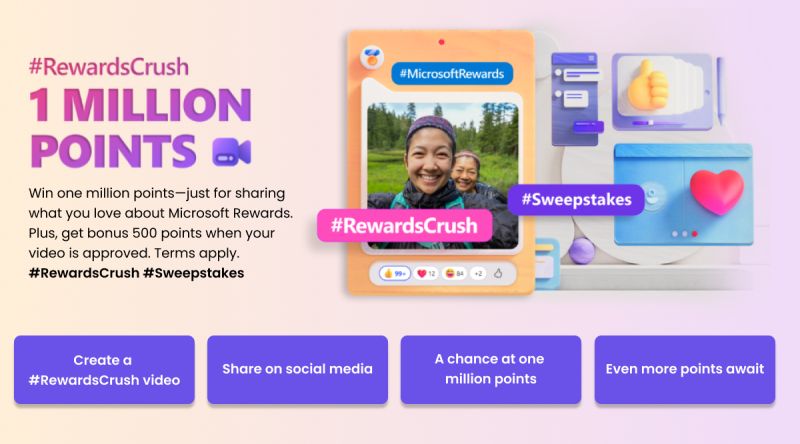
The Microsoft Rewards #RewardsCrush sweepstakes, which ran in the United States, shows this mechanic in action. Participants created a short video sharing what they love about Bing, posted it to Instagram, X, or TikTok with #RewardsCrush #Sweepstakes, and submitted their link through the entry form. Every approved video earned 500 bonus points, meaning participation itself was rewarded, not just winning. Five grand prize winners received one million points each.
Behind that experience, social content is absorbed and moderated at scale, secure winner draws are conducted, and prizes are fulfilled, all administered end to end. IC Engage administers promotions for Microsoft Rewards and is named by Microsoft as its verified prize partner, contacting winners on Microsoft’s behalf and awarding prizes.
The promotion doesn’t just generate entries. It generates opt-ins, organic sharing, and a participation experience that a passive points balance never could.
Your loyalty members already want to talk about your brand. The ones who enrolled and went dormant didn’t leave because they stopped caring. They left because the program stopped giving them something worth doing.
A structured UGC promotion gives them a reason to participate and gives you something measurable to bring back to leadership. Participation numbers. Opt-in rates. Organic reach. Content that keeps working after the campaign ends.
This is the infrastructure IC Engage has built and used to help brands thrive for over 35 years, across promotions that span industries, borders, and audiences. The mechanic isn’t new. Most brands just haven’t been running it like one.
A UGC promotion is a structured campaign in which consumers submit their own content, typically a photo or short video, to earn entries or rewards. It has defined entry mechanics, a prize, a moderation layer and a formal winner selection process. It is distinct from a UGC content campaign, which collects and reposts content without a promotional structure.
A content campaign is measured in reach, impressions and engagement, and is usually managed by a social or content team as a media cost. A promotion is measured in participation rates, opt-ins and re-engagement. The same submitted content can serve both, but only the promotion structure captures data and drives measurable member behaviour.
Yes. Dormant members generally have not lost interest in the brand, they have run out of things worth doing inside the program. A UGC promotion gives them an action to take that is not another transaction, and rewards participation itself rather than only winning, which lowers the barrier for a member who has been inactive.
Recognition outranks prizes. 60% of consumers say the chance to be featured by the brand is their primary motivator, against 32% motivated by winning. For loyalty programs specifically, this means the mechanic that re-engages a passive member is often not a bigger prize but the experience of being seen by a brand they already care about.
Three things beyond the creative: a content moderation layer, a secure and legally defensible winner selection process, and prize fulfillment. Together these touch submitted content, entrant personal data and prize payment, each carrying its own compliance standard. That is why most brands run these promotions with a partner already certified to handle all three.
Because submitted content appears on brand-controlled surfaces, and anything harmful or off-brand that reaches a public surface becomes the brand’s problem. The industry standard is hybrid moderation, with AI handling initial volume and human reviewers handling flagged items, which allows thousands of submissions to be processed without failures reaching the public.
Yes, and the distinction is not academic. Contests, sweepstakes and lotteries are treated differently in law, and the applicable requirements include state registration, FTC disclosure rules, platform-specific entry conditions and cross-border compliance. Getting the classification wrong exposes the brand to legal risk regardless of how well the promotion performs.
Entry requires registration, which creates a natural and consented data capture point. Around one third of contest participants opt in to receive future communications from the brand. Because the opt-in is attached to a voluntary action the member wanted to take, the resulting list tends to be more engaged than one built from passive collection.
The Microsoft Rewards #BingCrush sweepstakes asked members to create a short video about Bing, post it to Instagram, X or TikTok with the campaign hashtags, and submit the link. Every approved video earned 500 bonus points, rewarding participation rather than only winning, with five grand prize winners receiving one million points each.
Measure participation rate, opt-in rate, organic sharing and re-engagement among previously inactive members, rather than reach and impressions alone. The content itself also continues to return value after the campaign closes, which means measurement should extend past the campaign window rather than stopping at the close date.