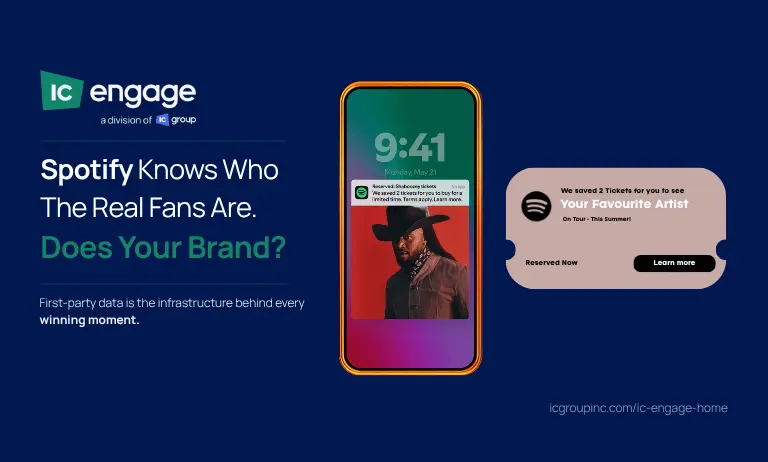
Last week, Spotify announced a new fan feature, Spotify Reserved. The short version: Spotify will identify an artist’s most dedicated fans based on their streaming behavior, hold 2 tickets for some of them, and give them a 24-hour window to purchase before the general sale.
The industry reaction was predictable. Great feature. Solves some of the secondary market problems around ticket access. Good for fans.
That framing undersells what Spotify built.
Spotify didn’t invent a new reward mechanic. Concert ticket contests have existed as long as concerts have. What Spotify built is the ability to look at years of behavioral signals and use that data to answer a genuinely hard question: who are artist’s biggest fans?
Once you can answer that question accurately, the reward almost does not matter. It could be tickets. It could be anything.
The power is in the customer recognition. “We see you. We know you showed up for this artist. We saved you a seat.”
That is not a promotion. That creates a powerful moment.
And the reason it lands the way it does is entirely because of the data layer underneath it. Without that, Spotify is just randomly selecting people and calling them fans.
Most brands don’t have ten-plus years of streaming history to draw from. But they do have access to behavioral data from their consumers, provided they design the right mechanisms to collect it.
That is exactly what a well-designed promotional campaign does. Mechanics such as a sweepstakes, an instant win, a gamified experience, a rebate program, when built intentionally, these are not just giveaways. They are data collection events. They tell you who your consumers are, what they care about, how they engage, and what motivates them to participate. Plus, it dramatically increases their engagement activity with you.
If you treat your promotions as one-time campaigns, you get one-time data. If you treat them as part of a longer consumer engagement strategy, you build the foundation to eventually do what Spotify just did: identify your real fans, deliver personalized rewards that mean something, and show them you care.
Spotify also noted they will monitor activity to confirm that the fans they reward are real people, not bots. They are not just selecting fans. They are validating them. That distinction matters because rewarding the wrong person, whether through error or manipulation, undermines everything the program is trying to do. Compliant, secure, defensible winner selection is not a background detail. It is what the whole thing depends on.
Spotify Reserved will expand. More artists, more tours, more markets. And allow another revenue stream for Spotify with ticket purchases direct. And other platforms are watching.
For brands that want to build toward something like this, the starting point is not technology. It is the decision to treat every consumer interaction as a data-generating event, and to design promotions that are built to tell you something about who your audience is.
The brands making that decision now are the ones who will have the foundation to deliver personalized, meaningful rewards later.
This type of engagement is what IC Engage helps global brands to build and has provided strategy and execution for more than 35 years.
Join our newsletter to stay informed with the latest IC Group announcements.
Orchestrating powerful digital connections between brands & people.
We use cookies to improve your experience and analyze how our website is used. Essential cookies enable core site functionality, while optional cookies help us understand usage and support marketing activities.
You can accept all cookies, reject non-essential cookies, or manage your preferences at any time.
Learn more in our Cookie Policy and Privacy Policy.
Manage your cookie preferences below:
Essential cookies enable basic functions and are necessary for the proper function of the website.