Popeyes just had its worst quarter in roughly 20 years.
Same-store sales fell 6.5 percent, the steepest drop the chain has seen in two decades. The company’s own leadership didn’t blame the menu. The chicken holds up against the competition. The problem was everything happening around it.
Popeyes’ new leadership put it plainly: a wave of limited-time offers brought new guests through the door, but most of them never came back, and the focus on chasing that trial traffic pulled attention away from the core guests who would have returned anyway.
That’s not an argument against promotions. It’s an argument for designing digital promotions that bring people back, not just designing them to bring people in.
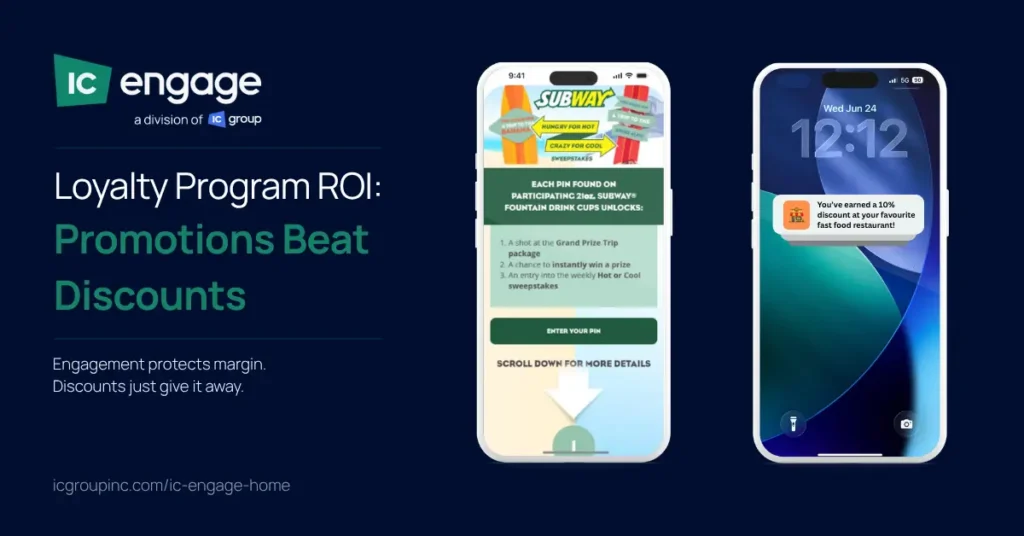
A discount asks nothing of the customer beyond using it. The brand learns nothing from that beyond the fact that someone redeemed a code. A digital promotion, even a basic one, asks for some kind of participation by choice, an entry, a scan, a visit, and that participation generates data a flat discount never produces. That’s the baseline advantage promotions have over discounts, before good design even enters the picture.
Design is still what determines how much that advantage is worth. Popeyes’ limited-time offers likely cleared that baseline bar. What they didn’t do was give guests a reason to engage with their brand or come back without another discount offer burning margin. The company’s own numbers tell the rest: the trial traffic never converted into repeat visits, and the attention spent chasing it came at the expense of the core guests who would have returned regardless.
This is where design separates a promotion that performs from one that doesn’t, and it’s the exact territory IC Engage has built in for years.
We’ve built the infrastructure that helped McDonald’s Monopoly manage millions of entries. It’s a board game most people grew up playing, so the mechanic needed no explanation. It turned a fast food visit into a collect-and-win game people came back for on their own. Subway’s Scrabble promotion did something similar using letter tiles instead of game pieces, and Wendy’s March Madness bracket challenge turned a basketball tournament into a reason to check back in with the brand for weeks, not once.
None of those needed a discount to bring people back. Promotion design did the work.
That distinction matters because of what happens once the data exists.
Mass discounting is frequently nonincremental: brands give up the margin without proof the discount changed anything. Companies that replaced standard discounts with personalized offers instead saw a real 2 to 4 percentage point improvement in gross margin.
Points and cashback alone aren’t enough to hold people anymore, either. More than a third of consumers plan to cancel at least one loyalty membership this year, a number that climbs past half among 18 to 34 year olds, despite the financial rewards still sitting right there in the app.
Even when people are enrolled in several programs, just over half say they really only engage with one. Enrollment isn’t engagement. What moves spending intent, particularly for younger consumers, is personalization, not a deeper discount.
Engagement pays off beyond the transaction too. Members who participate spend more, stay longer, and are more likely to recommend the brand to people who haven’t bought from it yet. That referral carries real weight: 92 percent of consumers trust a recommendation from someone they know more than they trust any form of paid advertising. A discount can move one sale. An engaged customer can bring in the next one without the brand spending another dollar to get it.
Put those findings together and a clear design chain forms.
Participation generates data: what someone chose, what they skipped, how often they came back.
That data is what makes personalization possible, not personalization in the shallow sense of inserting a first name into an email, but personalization that responds to what a specific customer wants.
That’s what makes a promotion sticky: the sense a customer gets that the brand is paying attention to them specifically, rather than running the same script on everyone. People don’t come back because of a coupon.
They come back because the brand started to feel like it knew them.
A discount skips every one of those steps and tries to buy the outcome directly, without ever building the part that makes someone want to return. The better a promotion is designed, the more of that chain it captures. Popeyes’ numbers show what happens when a promotion clears the first step and stops there.
The brands protecting their margin right now aren’t the ones discounting the loudest. They’re the ones building promotions designed for retention, not just redeemed once. That kind of promotion is measurably more profitable than a discount, because the engagement itself is what brings the customer back. A discount has to be repeated, usually at a deeper rate, just to get the same result. That’s the real ROI question worth asking before the next campaign goes out: does this earn a second visit on its own, or does it need another discount just to bring the customer back at all.
Join our newsletter to stay informed with the latest IC Group announcements.
Orchestrating powerful digital connections between brands & people.
We use cookies to improve your experience and analyze how our website is used. Essential cookies enable core site functionality, while optional cookies help us understand usage and support marketing activities.
You can accept all cookies, reject non-essential cookies, or manage your preferences at any time.
Learn more in our Cookie Policy and Privacy Policy.
Manage your cookie preferences below:
Essential cookies enable basic functions and are necessary for the proper function of the website.