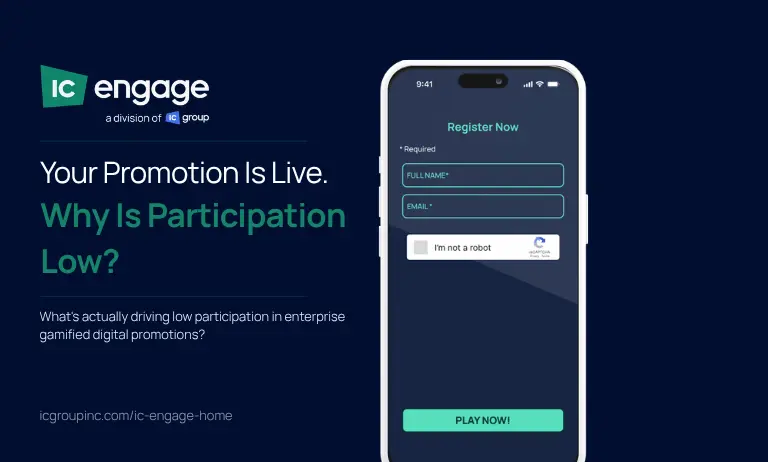
Most regulated enterprises aren’t running too few promotions. They’re running plenty, and a lot of them are quietly missing their targets. The teams behind them usually have a sense that something isn’t working but can’t point to a single cause, because there rarely is one.
There’s a tension in regulated industries that doesn’t get named enough. Compliance and security requirements are load-bearing. They can’t move. But the assumption has been that holding the line on those requirements means accepting a worse participant experience, and that means lower participation. That assumption is what this piece is about, because it’s wrong, and it’s costing regulated enterprises more than they realize.
Low participation in enterprise gamified digital promotions almost always comes from the same handful of problems stacking on top of each other.
The mechanic was built for the warmest person in the audience, not the coldest. The entry flow asks more of the participant than it should. The experience was built for desktop and most people are on their phones. Personalization is either missing or obvious enough to feel hollow. And buried somewhere in the process, security requirements added friction that participants feel even if they can’t name it.
None of these are fatal on their own. Together, they are.
Loyalty program members are already in your ecosystem. They opted in, they know the brand, and they have some existing reason to engage. Enterprise promotional audiences are often coming in cold. They’re encountering the promotion, and sometimes the brand, for the first time.
That changes what the mechanic has to do. It can’t rely on existing goodwill or habit. It has to be immediately legible, worth the time on its own terms, and compelling enough that someone with no prior relationship with the program actually finishes it.
Most enterprise mechanics aren’t built with that person in mind. They’re built for the best-case participant. IC Engage has run gamified promotional programs for Microsoft, PepsiCo, Bausch + Lomb, Disney, and others. The ones that outperform are the ones that were designed for the coldest person in the audience, not the warmest.
Every extra step in an entry flow costs participants. An authentication wall that wasn’t expected. A form asking for more than it needs. A redirect that drops mobile users before they finish.
These feel like small things from the inside. They aren’t. And they’re almost always invisible to the people building the promotion because those people aren’t coming to it cold, on a phone, with no patience. IC Engage designs entry flows with one goal at the center: get the participant to the moment of engagement as fast as possible, and remove anything that stands between them and it.
Over 70 percent of promotional entries happen on mobile. Designing for desktop and adapting isn’t the same as building mobile-first, and participants feel that difference even when they can’t articulate it.
For regulated enterprises, the mobile problem has a second layer. Digital promotion security on mobile has to be genuinely rigorous and completely invisible to the participant at the same time. Most teams treat these as separate problems, a security decision and a UX decision made by different people at different points in the build. When that happens, the security layer almost always ends up adding friction the participant shouldn’t have to feel.
When mobile security is handled at the infrastructure level from the beginning, the experience stays clean. The participant moves through the flow without interruption. The compliance requirements are still being met underneath it. They just never surface as a wall. IC Engage builds every promotional experience mobile-first with that separation built in from the start.
Participants expect experiences that respond to who they are, not just experiences that use their name.
For regulated enterprises, personalization carries a compliance dimension that most platforms don’t account for. Using audience data to deliver different experiences means that data has to be collected, stored, and processed within the same compliance infrastructure as everything else in the program. Most regulated enterprises under-personalize not because they don’t have the data, but because they haven’t solved that layer yet. They’re sitting on the capability and not using it because the risk feels unclear.
The regulated enterprises doing this well solved the data compliance problem first and built personalization on top of it. IC Engage’s platform handles that compliance layer at the infrastructure level, which means delivering different creative treatments, different prize tiers, and different mechanic flows to different audience segments through a single campaign isn’t a legal risk. It’s just how the program runs.
This is where regulated enterprises get stuck most often, and the instinct is understandable even if the conclusion is wrong.
The thinking goes: compliance requirements constrain what we can build. Constraints mean a worse experience. A worse experience means lower participation. So there’s a ceiling on how well a regulated enterprise can perform. That logic holds if your compliance layer is something you bolt onto a finished product. It excels when compliance is part of the architecture from the beginning.
Secure gamification isn’t about making compliance less limiting. It’s about designing promotions where the security infrastructure is the foundation everything else sits on. When that’s true, it stops creating friction and starts creating confidence. Regulated enterprises that get this right can move faster and take bigger creative swings, because the foundation doesn’t shift under them.
IC Engage has operated in regulated markets for over 35 years, ISO 27001 certified and compliant with both PCI DSS and GDPR. That track record isn’t a credential to put in a footnote. It’s the reason the enterprises we work with can run high-participation programs across multiple markets without compliance becoming a bottleneck.
It’s not budget. It’s not prize value.
The mechanic was built for the coldest person in the audience and worked for everyone else too. The entry flow didn’t get in the way. The experience was built for the device people use. Personalization ran underneath without announcing itself. Security was part of the architecture, not something applied afterward.
That’s what IC Engage builds. If your participation numbers aren’t where they should be, the answer is sitting in one of those fundamentals.
Join our newsletter to stay informed with the latest IC Group announcements.
Orchestrating powerful digital connections between brands & people.
We use cookies to improve your experience and analyze how our website is used. Essential cookies enable core site functionality, while optional cookies help us understand usage and support marketing activities.
You can accept all cookies, reject non-essential cookies, or manage your preferences at any time.
Learn more in our Cookie Policy and Privacy Policy.
Manage your cookie preferences below:
Essential cookies enable basic functions and are necessary for the proper function of the website.