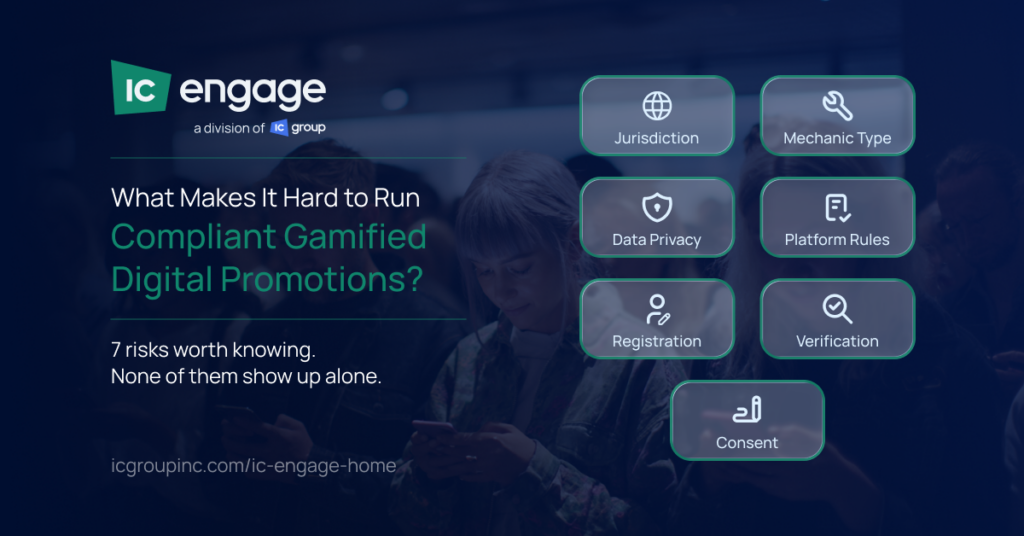
Running compliant gamified digital promotions is a challenge. The risk isn’t in one place. It can be spread across seven: jurisdiction, mechanic classification under lottery law, data privacy, platform rules, prize registration deadlines, winner verification, and post-entry marketing consent.
Gamified promotions are one of the most effective consumer engagement formats available to enterprise marketing teams. The mechanics are proven. The first-party data they generate gives brands a direct relationship with their customers, not one filtered through a platform or a third party.
The complexity doesn’t announce itself. A promotion can be designed, approved, and launched by an experienced team without identifying the compliance gaps sitting inside it. Those gaps surface after, not during.
In April 2025, the Federal Trade Commission (FTC) issued an $18 million consumer refund against one of the most recognized sweepstakes operators in North America. Not a new entrant. Not a brand cutting corners. An organization with decades of experience in exactly this space. The exposure wasn’t about intent. It was about infrastructure that hadn’t kept pace with where regulatory expectations had moved.
That’s the pattern behind every compliance failure in this category. The seven risks included below are where it can happen.
Digital promotion regulations aren’t determined by where a brand is headquartered. They’re determined by where each participant is located. For a campaign running across multiple markets, that means a single promotion is subject to a different legal framework in every jurisdiction it touches. Most enterprise teams design for one market and assume the rest follow. They don’t.
Quebec is one of the most cited examples in North American promotions law. The province’s French-language requirements are strict enough that many brands exclude Quebec residents entirely rather than build out compliant French-language materials and mechanics. That’s a legitimate strategy. It’s also a decision to write off Canada’s second most populous province before the campaign begins.
The international picture is more demanding still. Italy requires a local representative, a government filing, a notarized prize draw, a bond equal to the full prize value, and unclaimed prizes donated to charity. Canada requires winners to answer a skill-testing question before any prize is awarded. These are standard requirements in markets enterprise brands operate in regularly, not edge cases.
A promotion can clear every internal legal review and still be non-compliant in multiple markets the moment it goes live. The review happened. It just only covered one jurisdiction.
Every gamified promotion sits on a legal spectrum defined by three elements: prize, chance, and consideration. Consideration means something of value exchanged to enter, most commonly a purchase. When all three are present simultaneously, the promotion is legally classified as a lottery. Running one without a government licence is illegal in most jurisdictions. Sweepstakes avoid this by removing consideration. Skill contests avoid it by removing chance, selecting winners on skill or merit instead. Both are legal. Gamification compliance breaks down in how they get built.
If a skill contest uses a random draw to break a tie between participants, it legally reverts to a sweepstakes at that point, regardless of how the rest of the promotion was structured. That decision is typically made in a mechanics meeting, quickly, without legal review present.
A second dimension of this risk involves the alternate method of entry (AMOE) that must accompany any promotion with a paid entry pathway. Regulators have long applied what’s called the equal dignity standard: the free entry method must offer the same opportunity at the same prizes as the paid one. If paid entries are unlimited, the AMOE must allow unlimited entries too. A mail-in AMOE for a digital sweepstakes is still valid, as long as brands build in enough lead time for mail to realistically arrive before the entry deadline.
Where this trips brands up is treating the AMOE as a formality rather than a genuinely equal pathway. An AMOE that caps entries when the paid method doesn’t, or sets a deadline mail can’t realistically meet, fails the standard even though an alternative method technically exists.
Both risks live in the mechanics design phase, before legal review typically enters the process.
Every entry form in a gamified promotion is a data collection event. A name, an email address, a phone number. The moment that data is submitted, data privacy laws activate, and the marketing compliance challenge isn’t about knowing which laws exist. Most enterprise teams know the General Data Protection Regulation (GDPR) and California Consumer Privacy Act (CCPA) exist. The challenge is that they govern data collection differently.
Under GDPR, brands must identify a lawful basis for collecting and processing personal data. Consent is one option, but not the only one. The appropriate basis must be documented and defensible for each type of data collected and each purpose it serves. CCPA requires brands to disclose what data they’re collecting and why, and give consumers a clear right to opt out of the sale or sharing of their data.
These two frameworks don’t align precisely. Beyond them, more than 20 US states now carry their own comprehensive privacy laws with their own specific requirements. A brand that builds one global data handling approach and deploys it across all markets is almost certainly non-compliant somewhere without knowing it.
It’s critical for promotions and engagement teams to have a resource that is able to address the nuances of data privacy requirements differently depending on where each participant is located. This makes multi-jurisdictional compliance manageable rather than a recurring liability.
IC Group holds ISO/IEC 27001 certification for its information security management system, and maintains PCI DSS and GDPR compliance. That foundation is what makes IC Group the right partner for brands running promotions across multiple markets.
Running a gamified promotion on a social platform means accepting that platform’s own ruleset on top of every legal requirement already in play. Most teams know this in theory. In practice, platform obligations are where user engagement rules fall through the gap between legal, marketing, and the team managing execution, because they sit at the intersection of all three and aren’t claimed by any of them.
Every major platform requires a mandatory disclaimer on promotional content confirming that the platform itself isn’t a sponsor. It’s consistently one of the most commonly omitted disclosures in multi-platform campaigns, particularly when terms drafted for one platform get replicated across others without review. TikTok’s community guidelines refresh in September 2025 made commercial content disclosure mandatory for all promotional posts, requiring brands to use built-in platform tools rather than self-managed disclosures. Platform policies move like this regularly, and they don’t wait for campaigns already in market to catch up.
The risk compounds across channels. A promotion running across mobile, web, and social simultaneously is satisfying multiple parallel compliance tracks. What clears on one platform may not clear on another.
Promotion registration and prize administration are where laws and regulations become operational reality, and where most enterprise teams are furthest behind. It’s consistently treated as a marketing function. It’s regulatory infrastructure.
Before a promotion goes live in New York or Florida, any prize pool above $5,000 must be registered with state authorities and backed by a surety bond, a financial guarantee that the prizes advertised will actually be awarded. Florida’s strict filing deadline is a minimum of seven days before launch, and missing it will draw a fine. Rhode Island’s threshold is $500. Many brands sidestep this entirely by voiding the promotion in states with registration and bonding requirements, written directly into the official rules, rather than filing in every market the promotion touches.
The administration obligation runs deeper than registration. Official rules drafting, entry validation, fraud monitoring, winner selection, tax documentation, and structured reporting all carry their own compliance exposure. In the US, any prize valued at $2,000 or more requires a W-9 collected from the winner and a 1099-MISC issued by the brand. It’s one of the most consistently overlooked requirements in campaign planning and one of the most reliably discovered at the fulfillment stage, after the campaign has already closed.
The brands that handle this well treat prize administration as a discipline with its own timeline running parallel to the campaign. Not something that starts when the promotion does.
When a high-value prize is awarded, the brand needs to prove the outcome was legitimate. Not internally. To regulators, to participants, and if necessary, in a legal challenge. That requires a documented, defensible record of every step in the selection process, from how entries were validated to how the winner was chosen.
The fraud dimension makes this harder than it used to be. A promotions firm administering approximately 200 campaigns in 2024 reported more fraud attempts than in any previous year in its history. AI-powered bots can now bypass CAPTCHAs, flood entry pools, and distort performance data in ways basic validation tools can’t detect. An entry pool compromised by fraudulent submissions doesn’t just affect the promotion’s integrity. It affects the defensibility of every result that came out of it.
The automation question adds another layer. Brands increasingly use AI to manage winner selection and fraud prevention. Without documented randomization methods and human oversight at the point of awarding prizes, an automated process isn’t defensible if challenged. Efficiency isn’t the same as auditability.
Best practice in 2026 calls for real-time winner verification and a complete audit trail for every outcome. When a prize is awarded, the record exists. That’s not a feature. For brands running gamified promotions at scale, it’s the difference between a result that can be defended and one that can’t.
Entering a promotion isn’t consent to receive marketing communications. These are two distinct legal acts, and the entry form is consistently where they get merged into one.
Under Canada’s Anti-Spam Legislation (CASL), marketing consent must be express, separately obtained, and documented with proof of when it was given, what the participant agreed to, and how they provided it. GDPR holds the same position: a single checkbox bundling promotion entry with marketing opt-in doesn’t comply. Pre-checked marketing boxes don’t comply. Under both frameworks, consent must be a specific, active, separate action.
The reason this sits last isn’t because it’s the smallest risk. It’s because it’s the one that surfaces latest. The promotion closes. The entry list moves to the CRM team. Sends go out. Nobody verified whether the consent collected was valid for marketing purposes. What makes compliant gamified digital promotions genuinely difficult to run isn’t any single one of these seven risks. It’s that this one is invisible until the campaign is long over and the damage is already done.
Taken individually, each of these seven risks is manageable. The challenge for promotions and engagement teams running campaigns at enterprise scale is that none of them operate individually. A consent flow built for one market can fail the moment the promotion expands into another. A platform selection changes the jurisdictional exposure of the whole campaign. A prize structure determines what audit trail is required before a single entry is collected. They interact, and they interact in ways that a final legal review before launch isn’t designed to catch.
The brands that run these campaigns confidently aren’t the ones with the largest legal teams. They’re the ones whose operational infrastructure handles these layers from the point of brief. Compliance built into the architecture of a promotion produces a fundamentally different outcome than compliance reviewed at the end of one.
IC Engage has been navigating these risks for over 35 years, across enterprise campaigns for some of the world’s most recognized brands. The complexity doesn’t shrink. The infrastructure to manage it gets sharper.
Yes. Digital promotion regulations are determined by where each participant is located, not where the brand is headquartered. A single campaign is subject to a different legal framework in every jurisdiction it touches, from Quebec’s French-language requirements to Italy’s local representative and bonding rules to Canada’s mandatory skill-testing question.
A promotion is legally classified as a lottery when prize, chance, and consideration are all present, and running one without a government licence is illegal in most jurisdictions. Sweepstakes avoid this by removing consideration, meaning no purchase is required to enter. If a promotion also offers a paid entry pathway, it must include a free alternate method of entry (AMOE) that meets the equal dignity standard: the free entry has to offer the same opportunity as the paid one, not a reduced version of it.
Yes, and the two frameworks don’t align precisely. The General Data Protection Regulation (GDPR) requires brands to identify a lawful basis for collecting and processing personal data, with consent as one option, not the only one. The California Consumer Privacy Act (CCPA) requires brands to disclose what data they’re collecting and why, and give consumers a clear right to opt out of its sale or sharing. More than 20 US states now have their own comprehensive privacy laws.
Yes. Every major platform requires a disclaimer confirming the platform itself isn’t a sponsor of the promotion, a disclosure that’s commonly omitted when terms built for one platform get reused on another. Platform rules also change independently of the law. TikTok’s September 2025 community guidelines update made commercial content disclosure mandatory using the platform’s own built-in tools rather than self-managed disclosures.
In New York or Florida, any prize pool above $5,000 must be registered with state authorities and backed by a surety bond before launch, with Florida requiring filing at least seven days ahead. Rhode Island’s threshold is $500. Separately, any prize valued at $2,000 or more in the US requires a W-9 collected from the winner and a 1099-MISC issued by the brand.
With a documented, defensible record of every step in the selection process, from entry validation to how the winner was chosen. This matters more as fraud increases. AI-powered bots can now bypass CAPTCHAs, flood entry pools, and distort performance data in ways basic validation tools can’t detect, and if AI is used for winner selection, it needs documented randomization methods and human oversight to be defensible if challenged.
No. Entering a promotion and consenting to marketing communications are two separate legal acts. Under Canada’s Anti-Spam Legislation (CASL), marketing consent must be express, separately obtained, and documented with proof of when it was given, what was agreed to, and how it was provided.
Join our newsletter to stay informed with the latest IC Group announcements.
Orchestrating powerful digital connections between brands & people.
We use cookies to improve your experience and analyze how our website is used. Essential cookies enable core site functionality, while optional cookies help us understand usage and support marketing activities.
You can accept all cookies, reject non-essential cookies, or manage your preferences at any time.
Learn more in our Cookie Policy and Privacy Policy.
Manage your cookie preferences below:
Essential cookies enable basic functions and are necessary for the proper function of the website.